
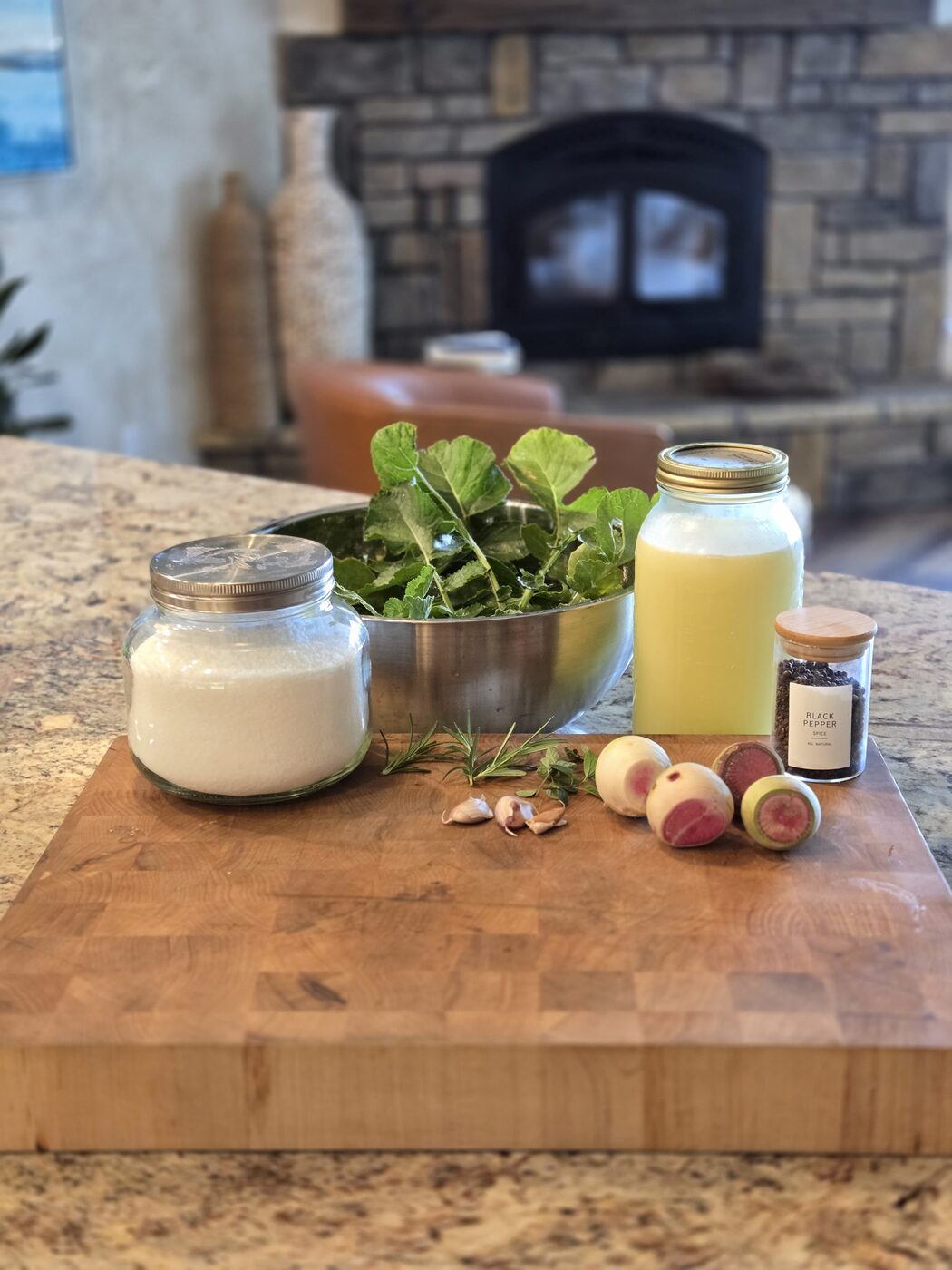
The Terrain Series, No. 10. A series on how everyday food shapes the body's inner terrain — the conditions that either invite disease or help keep it at bay. This week: angiogenesis, the blood-supply hallmark, and an honest accounting of what the food evidence does and doesn't show.
Here's a fact that reframed how I think about early cancer: a tumor cannot grow past roughly the size of a pinhead on its own.
Not because it isn't dividing. It is. But every cell needs oxygen and nutrients delivered, and waste carried away, and that only happens through blood vessels. A clump of cells sitting in tissue with no vessel of its own hits a ceiling fast. It starves in the middle.
So it does something remarkable, and genuinely unsettling. It sends out a chemical signal to the nearest blood vessels: come here. And they do. New capillaries sprout toward it, wire themselves in, and the ceiling disappears.
That process is called angiogenesis, and it's one of the ten hallmarks of cancer — the framework Hanahan and Weinberg laid out that has shaped cancer research for two decades.1
Angiogenesis isn't the villain
This is the part that surprised me, and it matters.
Growing new blood vessels is a completely normal, necessary thing your body knows how to do. It's how an embryo develops. It's how a cut on your hand heals — new vessels move in to supply the repair. It's part of the monthly rebuilding of the uterine lining.
In a healthy adult, though, it's kept on a very short leash. Angiogenesis is tightly regulated by a balance of promoters and inhibitors, and outside of healing and menstruation, it mostly stays switched off. Your body is not supposed to be casually laying new pipe.
Cancer doesn't invent a new ability. It hijacks one you already have and jams the switch on.
VEGF: the message that summons the vessels
The main promoter has a clunky name: vascular endothelial growth factor, or VEGF. Think of it as a flare. When tissue needs blood supply, it releases VEGF, and nearby vessels read the signal and start growing toward it.
A tumor short on oxygen releases VEGF too — a lot of it, and constantly. It activates the proteins that crank up VEGF production and essentially never stops sending the flare. The vessels that respond are often disorganized and leaky, but they're enough. The tumor gets its supply line.
This is not a fringe idea, and it isn't only a nutrition story. Blocking VEGF is the entire basis of a class of cancer drugs already in clinical use. Angiogenesis is one of the best-validated targets in oncology.
Which naturally raises the question I get asked in some form almost every week: is there anything on my plate that does that?
What the food research actually shows
There is real research here. I want to walk you through it honestly, which means telling you both what was found and what kind of study found it.
Two compounds have the strongest anti-angiogenic evidence behind them, and both come from unglamorous food:
- Luteolin — found in thyme (by far the richest source), celery, green peppers, peppermint, rosemary, oregano, and olive oil. In laboratory and animal work, luteolin blocks VEGF-driven vessel growth by interfering with the signaling pathways endothelial cells use to survive and multiply, and lowers how much VEGF gets made in the first place.2
- EGCG — the main catechin in green tea. It suppresses VEGF production, interferes with the VEGF receptor, and dampens the oxygen-sensing protein that tells a starving tumor to send the flare at all.3
Your kitchen probably already has both. Thyme is a two-dollar bunch. Celery is the thing wilting in the crisper drawer.
The honest part
Nearly all of this is preclinical — cells in dishes and tumors in mice. The 2023 review of luteolin says it plainly: no clinical trials have tested luteolin as a cancer therapy in people. And with green tea there's a specific catch worth knowing — only a small fraction of the EGCG you drink ever reaches your bloodstream, so the concentrations that work in a laboratory dish are far above what a cup of tea delivers to your tissues.3
That's not a reason to skip the tea or the thyme. It is a reason to be skeptical of anyone selling you a concentrated extract and a promise.
Why the gap argues for food, not pills
We've been here before in this series. When researchers took beta-carotene — wonderful in food, protective in every population study — and gave it as a high-dose supplement, lung cancer rates went up in smokers. Two large trials, same unwelcome answer.
Isolating one compound and pushing the dose is a genuinely different intervention from eating the food it came from. Even in my own coursework, resveratrol is the standing example: beautiful anti-angiogenic activity on paper, and clinically disappointing in humans, largely because so little of it survives absorption.
So I'd put it this way. The mechanism is real and well-established. The specific claim that eating thyme shrinks a tumor's blood supply in a human being is not established, and I'm not going to tell you it is. What we have is a plausible mechanism, consistent laboratory findings, and a dietary pattern — herbs, vegetables, olive oil, tea — that carries essentially no risk and a great deal of other well-documented benefit.
That's enough for me to cook this way. It isn't enough for me to promise you anything, and you should be wary of anyone who does.
Bring it to your plate
Small, repeatable things. No overhaul.
- Use fresh thyme like you mean it. It's the richest luteolin source in the kitchen and it's usually treated as a garnish. Strip a few sprigs into soups, beans, roasted vegetables, eggs.
- Stop throwing away celery leaves. The leaves carry more of the good compounds than the stalks, and they taste like a cross between celery and parsley. Chop them into whatever you're making.
- Buy celery organic and eat it within about a week — its antioxidant content drops off noticeably as it sits.
- Green tea, brewed gently. Bring the water barely to a boil, let it cool a moment, then steep. Boiling water scorches the leaves and turns it bitter. A squeeze of lemon helps you absorb more of the catechins.
- Cook with olive oil and finish with more of it. It carries luteolin itself, and fat helps you absorb a lot of what else is in the pot.
- Lean on the herb drawer generally — parsley, oregano, rosemary, peppermint. Gram for gram, herbs are some of the most concentrated plant compounds you can eat, and nobody thinks of them as food.
I rebuilt my Italian penicillin soup around exactly this — celery and its leaves, a real handful of fresh thyme, garlic, ginger, and good olive oil, in a brothy base that's gentle on a low-energy day.
You don't need to hold any of this in your head at the stove. Herbs in the pot, leaves in the soup, tea in the afternoon. The mechanism is fascinating, but the practice is small — and the small practice is the part that actually happens.
Sources: 1 Hanahan, D., & Weinberg, R. A. (2011). Hallmarks of cancer: the next generation. Cell, 144(5), 646–674. | 2 Rocchetti, M. T., Bellanti, F., Zadorozhna, M., Fiocco, D., & Mangieri, D. (2023). Multi-faceted role of luteolin in cancer metastasis: EMT, angiogenesis, ECM degradation and apoptosis. International Journal of Molecular Sciences, 24(10), 8824. | 3 Talib, W. H., Awajan, D., Alqudah, A., et al. (2024). Targeting cancer hallmarks with epigallocatechin gallate (EGCG): mechanistic basis and therapeutic targets. Molecules, 29(6), 1373.