
Part 2 of a series. This post follows last week's raw milk and yogurt post — one gallon of raw milk, homemade Greek yogurt, and a jar of fresh whey I didn't know what to do with. That context helps, but you can read this one on its own.
If you've been following along, you know that last week's yogurt post left me with something I wasn't entirely sure what to do with: a generous jar of homemade whey. Something that takes that much patience to make deserves better than a sad sink goodbye. No whey…yes whey (Dad joke #1, you're welcome).
I have never used whey, know nothing about it, and was fully prepared to get rid of it…until I googled it…and there was rabbit hole #2 for me. After a few hours of research (don't judge, I do a lot of research on everything!), I decided I needed to use the whey to ferment something…but what??
And then I took my daily walk out to the garden and discovered my gorgeous hidden gems were ready for harvest — and I had my answer.
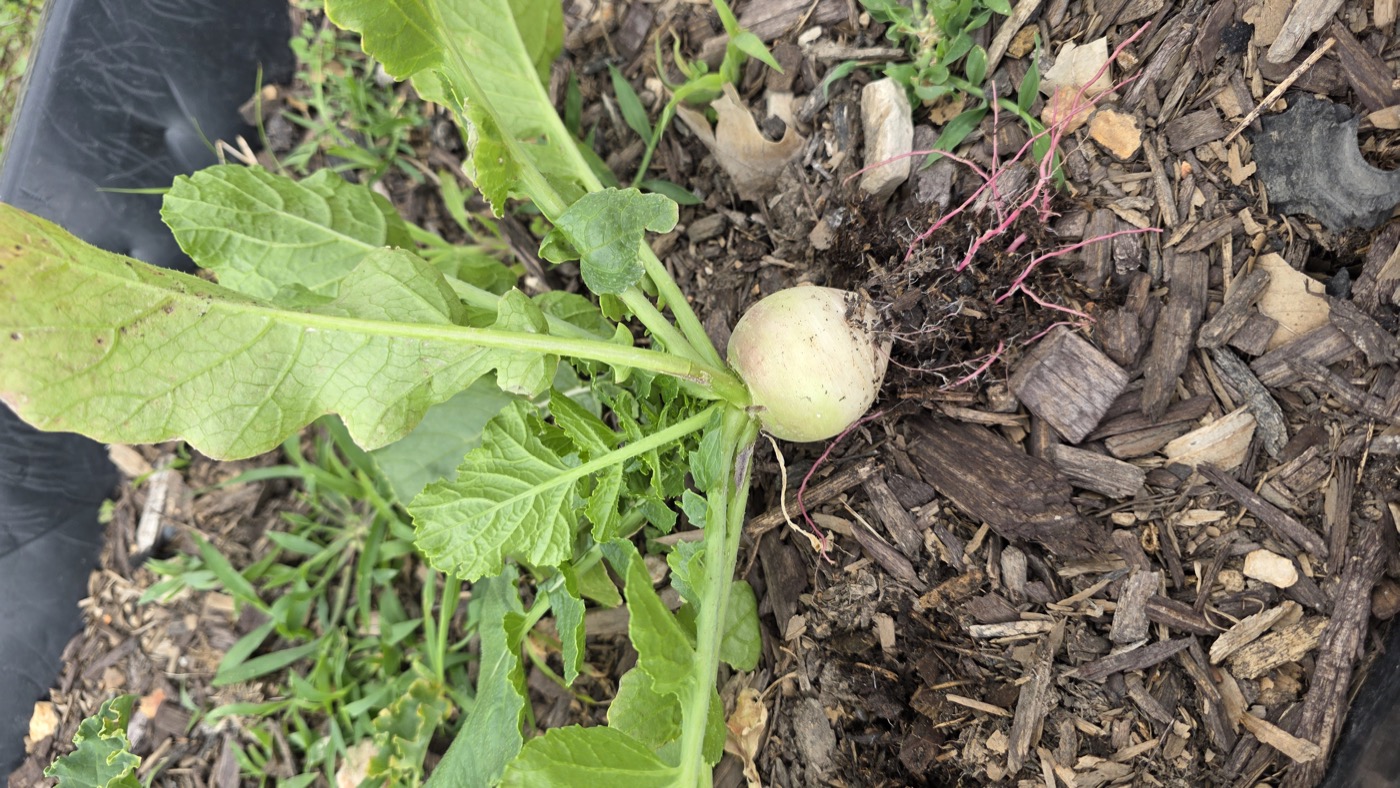
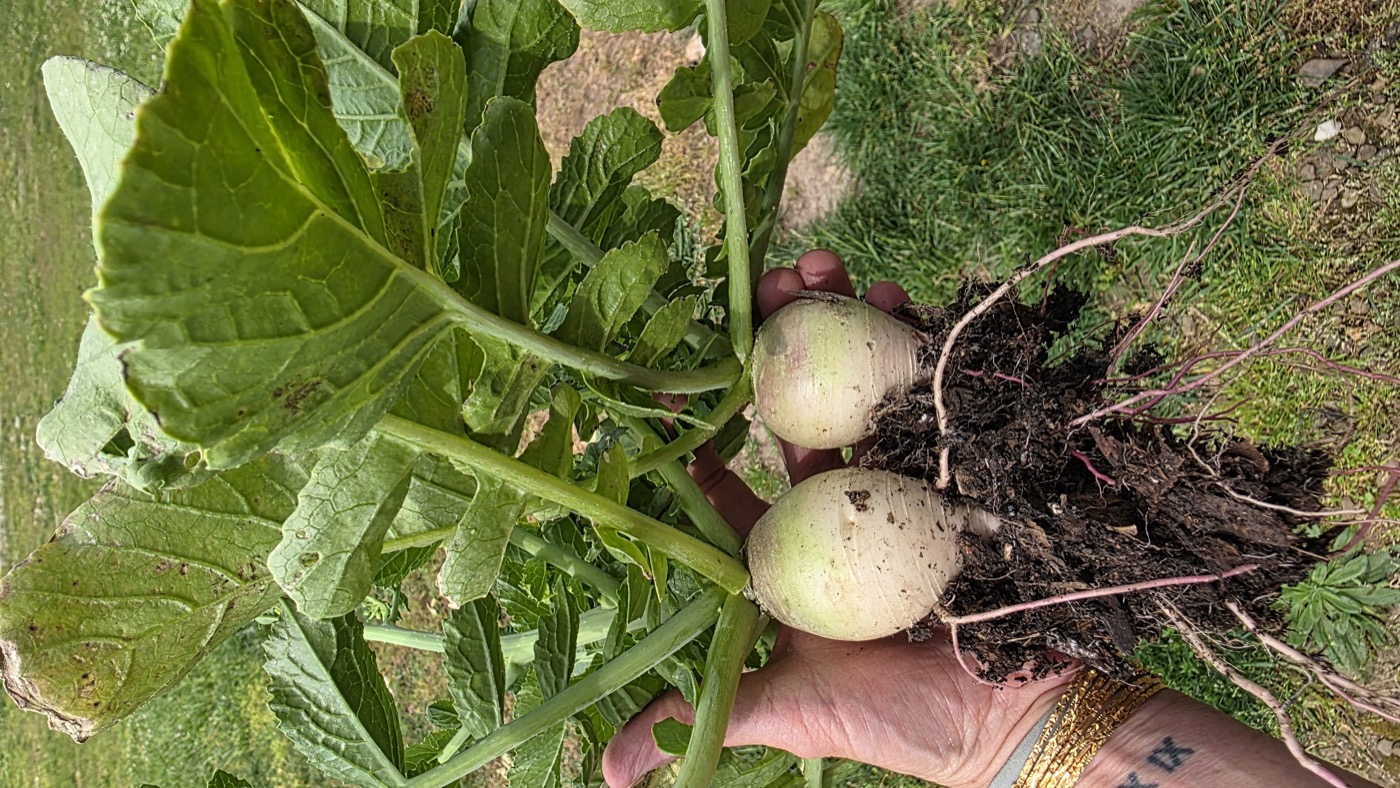
My watermelon radishes were ready. These beauties had been growing quietly in their raised bed, looking deceptively unremarkable from the outside — pale green and cream-colored globes poking up through the mulch. No hint whatsoever of what was waiting inside. (More on that in a moment.)
The timing felt like more than coincidence. Whey in the kitchen. Radishes in the garden. What followed was a three-day experiment that turned into one of the most genuinely exciting things I've done in this kitchen, and a super cool science lesson for this little nerd.
But before I get to the jar — do you know that there's an actual difference between vinegar pickling and fermentation? I didn't, and I talk about nutrition for a living. Both styles look identical in a jar. They're both sour. They're both preserved. But what they do inside your body? Completely different story. On top of that, I didn't know you can use whey to ferment. My husband's five words have literally changed my fermentation approach for the rest of my life.
Vinegar Pickling: The Quick Preserve
Vinegar pickling is what most of us grew up with. You make a brine — water, vinegar, salt, maybe a little sugar — pour it over vegetables, seal the jar, and you're done. Sometimes within hours. It's quick, reliable, and the results are delicious.
Here's what's happening: the acetic acid in vinegar creates an environment so acidic that bacteria can't survive. That's exactly the point — it's preservation through acidification. No bacteria in, no bacteria out. The jar is essentially sterile.
Vinegar pickling has genuine benefits worth acknowledging:
- It preserves the vegetable's nutrients reasonably well
- The acidity can help stimulate digestive enzymes when eaten alongside a meal
- Research suggests consuming acidic foods with higher-glycemic foods may help moderate blood sugar response
- It's consistent, shelf-stable, and honestly delicious
But here's the honest truth: vinegar-pickled vegetables contain no live probiotics. The process that makes them shelf-stable also makes them microbiologically inert. You're getting the flavor and some of the nutrients — but you're not getting living cultures. And that's exactly what your gut needs to thrive.
Whey Fermentation: The Living Alternative
This is where things get genuinely nerdy, and I am here for every second of it. And if you're still reading, apparently so are you.
Lacto-fermentation — using whey as a starter — is a fundamentally different process. Instead of introducing acid to preserve the vegetables, you're creating the conditions for bacteria to produce lactic acid themselves.
The whey from last week's yogurt was already alive with Lactobacillus bacteria — the same beneficial organisms that made my yogurt tangy and thick. When I poured that whey over a packed jar of watermelon radishes, I wasn't just adding liquid. I was introducing a thriving microbial community into a new food environment and letting them get to work.
Think of it like a construction crew showing up to a job site. The Lactobacillus bacteria in the whey didn't just arrive — they arrived experienced. They'd already built something (your yogurt), they knew the work, and when they moved into the radish jar they got straight to it. Consuming sugars, producing lactic acid, gradually transforming the environment around them. They didn't just preserve the radishes — they built something new inside that jar, one microscopic layer at a time.
As the bacteria consume the natural sugars in the radishes, they produce lactic acid as a byproduct. That lactic acid gradually lowers the pH of the brine, creating an acidic environment that preserves the vegetables while keeping the bacteria alive. It's preservation that happens through life, not in spite of it.
Here's what that means for your body:
Live probiotics — the real deal. Lacto-fermented vegetables contain genuinely live Lactobacillus cultures that survive into the final product. When you eat them, those bacteria can make it into your gut and contribute to the diversity and resilience of your microbiome — connected to everything from digestion and immune function to mood regulation. Up to 90% of your serotonin is produced in the gut. The healthier your microbiome, the better equipped your body is to support mood, focus, and overall wellbeing.
Increased nutrient bioavailability. Fermentation breaks down the cellular structure of vegetables in a way that makes their nutrients more accessible to your body. Research has consistently shown that lacto-fermented vegetables have higher levels of bioavailable vitamins and minerals than their raw or conventionally pickled counterparts. Your body absorbs more of what's actually in there.
B vitamin production. Lactobacillus bacteria produce B vitamins — particularly B2 (riboflavin) and folate — during fermentation. The radishes are literally generating nutrients that weren't there when I put them in the jar.
Enzyme support. The fermentation process produces beneficial enzymes that support digestion. A small amount of lacto-fermented vegetables before or alongside a meal can help prime your digestive system beautifully.
Antinutrient reduction. Fermentation helps break down compounds like phytic acid that can bind to minerals and block absorption. The result is a food that gives your body more access to its own nutritional content.
Glucosinolate activation — this one's specific to watermelon radishes. Watermelon radishes belong to the cruciferous family, alongside broccoli, cabbage, and kale. Cruciferous vegetables are rich in glucosinolates — compounds that convert in your body into protective molecules that support liver detoxification and have been studied extensively for their cancer-protective properties. Fermentation enhances glucosinolate metabolism, actively converting them into their bioactive forms — isothiocyanates and indole-3-carbinol — so your body has more immediate access to those protective compounds without having to do the conversion work itself.
What Actually Happened in the Jar
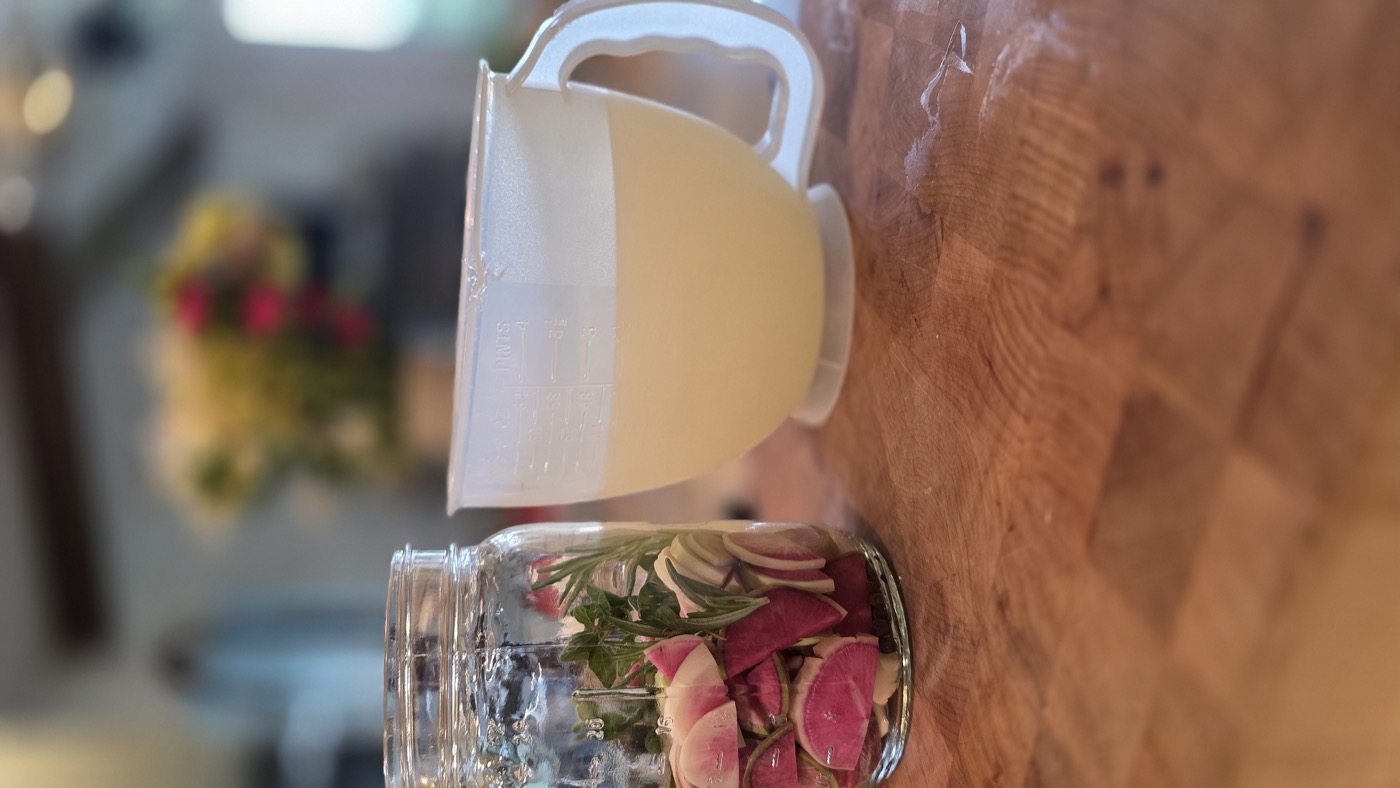
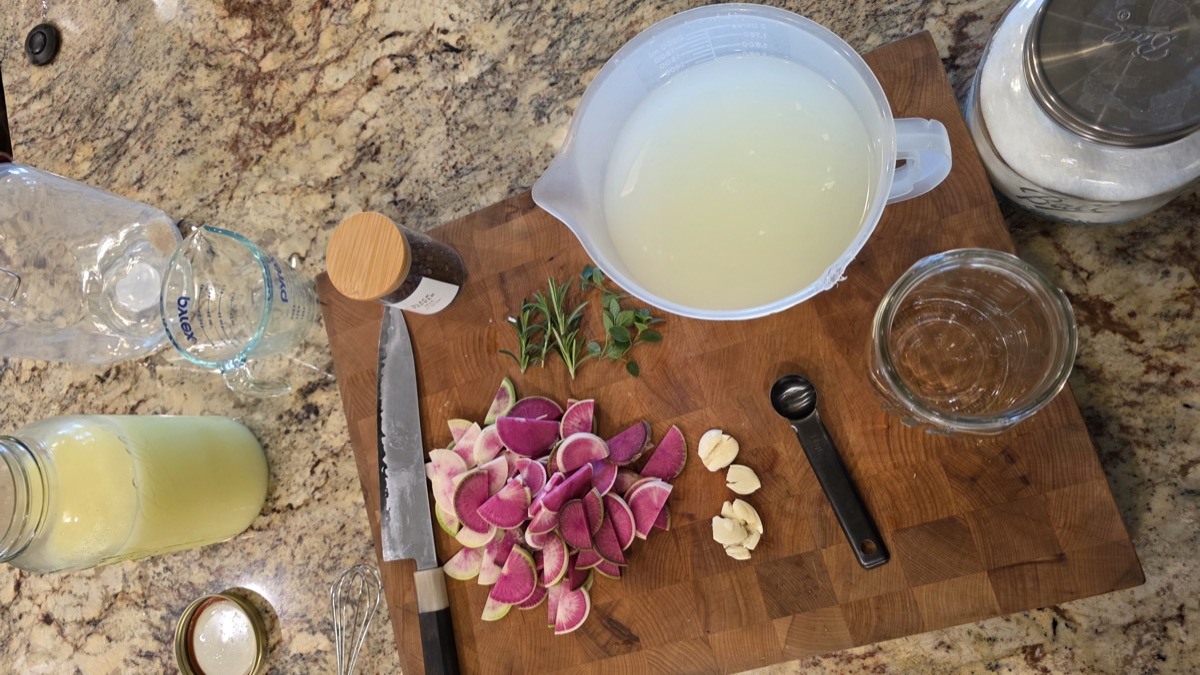
I packed sliced watermelon radishes into a clean jar with fresh garlic, rosemary, thyme, and black pepper. Salt went in. Then I poured the whey brine over everything, making sure the radishes were fully submerged. Lid on. Into the dark pantry. And then: patience.
Within 18 hours, there were bubbles. Actual, visible bubbles — carbon dioxide being released as a natural byproduct of bacterial fermentation. That's how you know it's working. You should have heard me giggling as I watched my radishes ferment in the whey that came from raw milk.
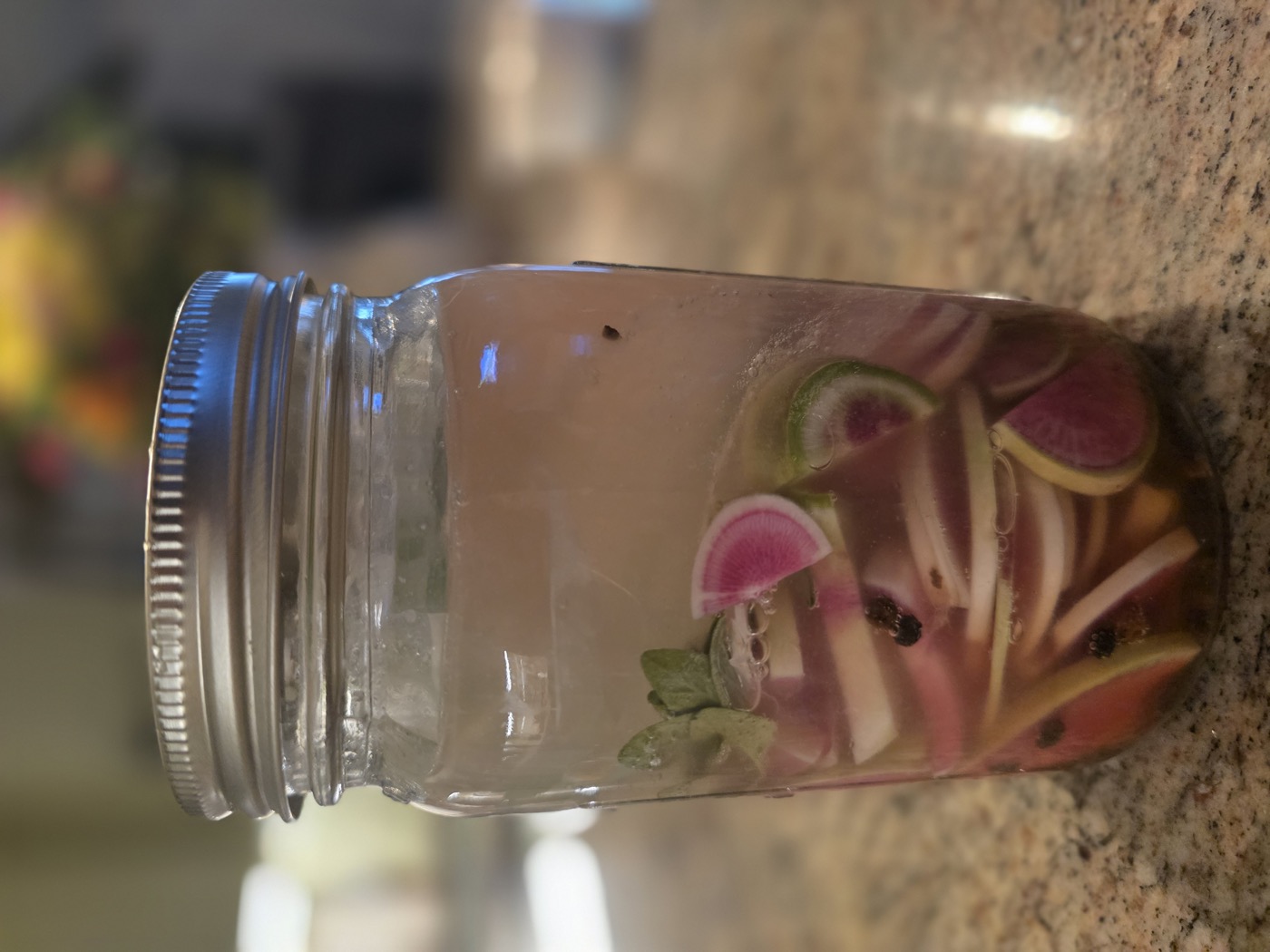
By day two, the brine had started to blush — a soft rosy tinge developing as the anthocyanins (the pigment compounds responsible for that stunning magenta interior) began leaching out of the radish flesh into the surrounding liquid. Anthocyanins are the color-makers of the plant world — natural pigments responsible for deep reds, purples, and magentas in food, and powerful antioxidants in your body.
The environment was becoming more acidic. The bacteria were doing their work. I tasted a slice and was blown away — subtle fermented flavor, slightly garlicky, very delicious. I was excited with a capital E.
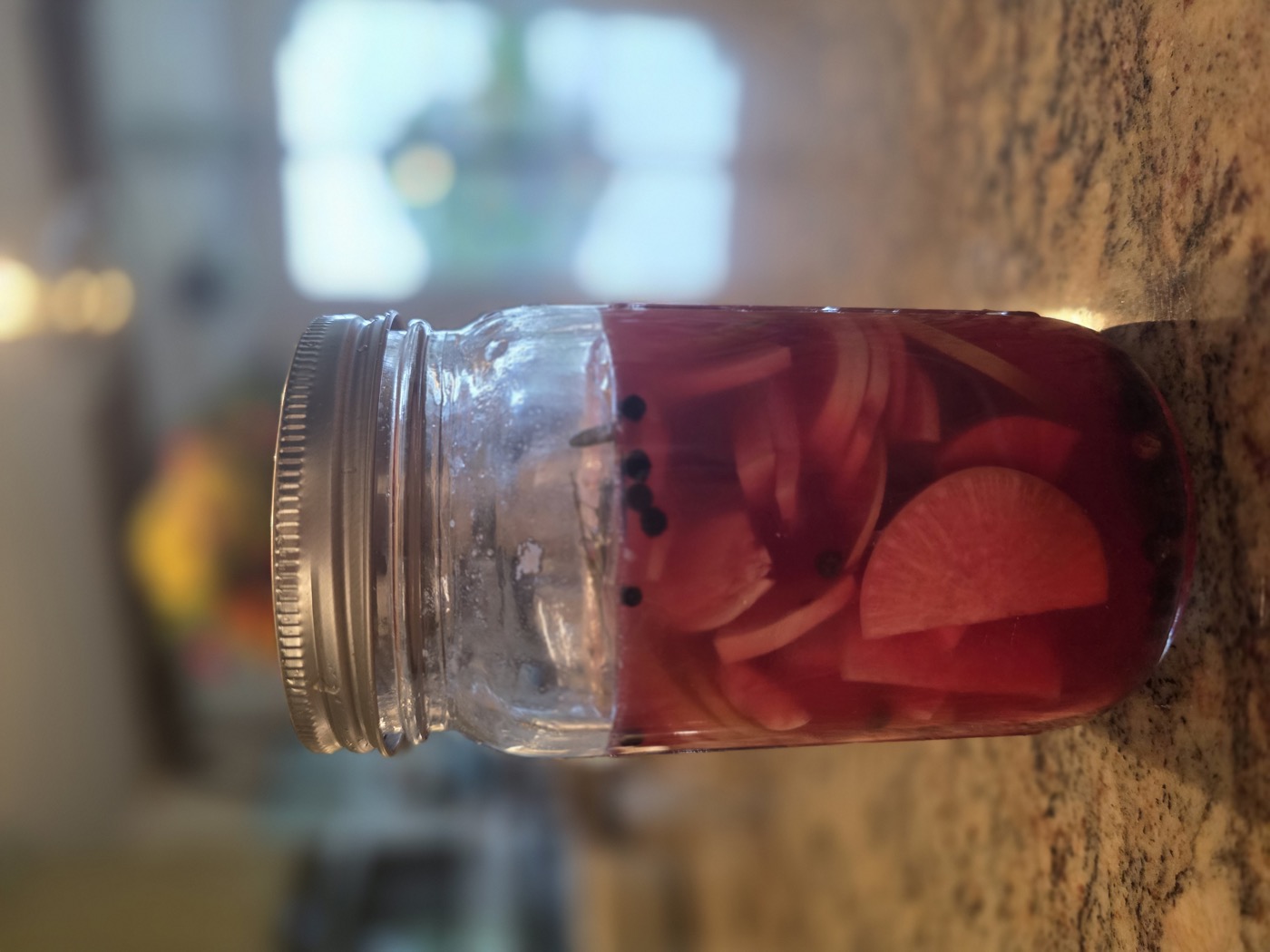
The morning of the third day came with a rolling thunderstorm, so I was up early — thanks to my elder dog, who is not a fan. At 5:30am, standing in the pantry, I was literally laughing out loud. The brine had transformed into a deep, jewel-toned magenta — the kind of color you'd expect from a craft cocktail, not a mason jar on a kitchen shelf.
This color shift is the anthocyanins reacting to the dropping pH. As the brine becomes more acidic, the pigment molecules change their structure and deepen in color. It's a built-in pH indicator: the more vibrant the color, the more active the fermentation. Your jar will literally tell you how well it's doing.
The Finished Jar — and the Brine That Deserves Its Own Moment
After three days at room temperature, the jar went into the refrigerator to slow the fermentation and preserve what was already there. The radishes had softened just slightly — still with a gentle bite — and the flavor was tangy, complex, a little funky in the best possible way.
Now, about the brine: please don't pour it down the drain. That liquid holds the same live cultures and lactic acid as the radishes themselves. It's fermented whey brine, and it deserves a place far beyond the jar.
Use it in a vinaigrette where you'd normally reach for vinegar. Add a tablespoon to grain-cooking water. Take a small amount straight before a meal as a gut-priming shot. It's probiotic-rich, mineral-dense, and deeply flavorful — treat it accordingly.
(A full post on using fermented brine is coming — this rabbit hole goes deep.)
The Circle Closes
What strikes me most about this experiment isn't the color, or the bubbles, or even the science — though all of that genuinely delights me. It's the circle of it.
The grass fed the cow. The cow gave us the milk. The milk gave us the yogurt. The yogurt gave us whey. The whey fed the bacteria. The bacteria transformed the radishes. The radishes grew in the garden just outside. Nothing wasted. Everything purposeful.
This is what food as medicine looks like in a real kitchen — not perfect, not complicated, not requiring anything you don't already have. Just curiosity, a little patience, and the willingness to let nature do what it has always done best.
More experiments are coming. This is just the beginning.
Sources: Cotter, P.D., Hill, C., & Ross, R.P. (2013). Fermented foods as a vehicle for delivering beneficial microorganisms. Annual Review of Food Science and Technology. | NutritionFacts.org — Dr. Michael Greger on cruciferous vegetables and glucosinolates. | Riso, R. et al. (2009). Glucosinolate content in turnip tops and turnip greens: effects of cooking. Food Chemistry.