
The Terrain Series, No. 7. A series on how everyday food shapes the body's inner terrain — the conditions that either invite disease or help keep it at bay. This week: what the endocrine system actually is, and the gentle ways food helps it stay in balance.
If you've ever been told "it's probably your hormones," you've bumped into the endocrine system — usually without anyone explaining what it actually is. It gets waved at during puberty, pregnancy, perimenopause, thyroid trouble, a stressful stretch. But most of us finish those conversations with no real picture of the system doing the talking.
So let's fix that, because once you understand what the endocrine system is, supporting it stops feeling mysterious and starts feeling like something you do at the kitchen table.
Think of it as your body's group chat
Your endocrine system is a network of glands — the thyroid in your neck, the adrenals on top of your kidneys, the pancreas behind your stomach, the ovaries or testes, the pituitary and pineal up in your brain — that communicate by sending hormones into your bloodstream.
Hormones are chemical messengers. The word literally comes from the Greek for "to stir up" or "to urge on" — little sparks that tell your cells what to do.1 One gland sends a message, the blood carries it, and a distant organ reads it and responds. Grow. Slow down. Store this. Release that. Ovulate. Sleep. Raise blood sugar. Calm down. It's a constant, quiet stream of texts keeping your metabolism, mood, energy, reproduction, and stress response all roughly on the same page.
Here's the part that makes it click: hormones only "land" where there's a matching receptor. Picture a message that only opens on the phone it was addressed to. A hormone floats along until it meets its receptor on a cell, the two connect, and that's what changes the cell's behavior. No receptor, no message received.
Every message gets a reply
Here's what keeps the group chat from spiraling: the messages get answered.
When a gland sends out a hormone and enough of it has been received, a reply comes back — "got it, you can ease off now" — and the gland stops sending. Scientists call this a negative feedback loop, but it's really just the read receipt that keeps anyone from over-texting.1 The system is always listening for that reply and adjusting, aiming for balance rather than blasting the same message on repeat.
Which brings us to the single most useful thing to understand about this system:
Everything is connected to everything
The glands don't operate in isolation — they're one interconnected web. Nudge one hormone and others shift in response.1 Stress raises cortisol, and cortisol touches blood sugar, sleep, immune function, and your sex hormones. Blood sugar swings pull on insulin, and insulin influences other hormones in turn. Pull one thread and the whole web moves.
That sounds like bad news. It's actually the best news in this whole post — because it means you don't have to chase one hormone at a time. When you tend the terrain — the daily conditions your whole body runs on — you support the entire network at once. You don't need to micromanage estrogen or cortisol individually. You create conditions where the group chat can regulate itself.
Here's where your fork comes in.

Four gentle terrain levers
1. Steady your blood sugar. This is the most underrated hormone lever there is. Every time blood sugar spikes and crashes, insulin and cortisol get pulled into the drama — and because everything's connected, the ripples reach the rest of the system. You steady it not with willpower but with structure: protein and healthy fat at every meal, fiber-rich plants, and going easy on the sugar and refined flour that set off the roller coaster. Boring, steady blood sugar is a gift to every other hormone you have.
2. Support your liver. Your liver is the body's processing plant for used-up hormones — it packages up what you're done with (like spent estrogen) so it can leave the body.2 When the liver is overwhelmed or the exit is sluggish, those hormones can get recirculated instead of cleared. Cruciferous vegetables — broccoli, cabbage, Brussels sprouts, cauliflower, kale — are the classic allies here, along with plenty of water and a genuinely colorful plate.
3. Feed your gut — the "estrobolome." This one surprises people. A specific community of gut bacteria, nicknamed the estrobolome, helps regulate how much estrogen gets escorted out of the body versus reabsorbed.3 A balanced, well-fed microbiome helps keep that traffic flowing the right direction. Fermented foods — yogurt, kraut, kimchi, fermented garlic — and the fiber that feeds your existing bacteria are how you support it. (This is exactly why I paired this post with a ferment. More below.)
4. Lower your load of endocrine disruptors. Some synthetic chemicals — called xenoestrogens or endocrine disruptors — are shaped enough like our own hormones to slip into those receptors and send scrambled messages.4 You'll find them in some plastics, conventional body-care products, and pesticide residues. You don't need to panic or overhaul your house overnight. A few quiet swaps do real work: stop microwaving food in plastic, choose glass or stainless when you can, filter your water, pick cleaner personal-care products, and buy organic for the foods that hold the most residue. Progress, not perfection.
The honest part
Two things, because you deserve the straight version.
First, interconnection cuts both ways. The same web that lets one good habit ripple outward means no single food "balances your hormones" on its own — and anything promising to is selling something. It's the overall pattern, held gently over time, that shifts the terrain. Sleep and stress care belong on this list every bit as much as food.
This is about supporting a healthy system, not diagnosing or treating one. If something feels genuinely off — persistent fatigue, cycle changes, thyroid symptoms — that deserves real testing and a real practitioner, not a guess. Food tends the soil. It works alongside your medical care, not instead of it.
Bring it to your plate
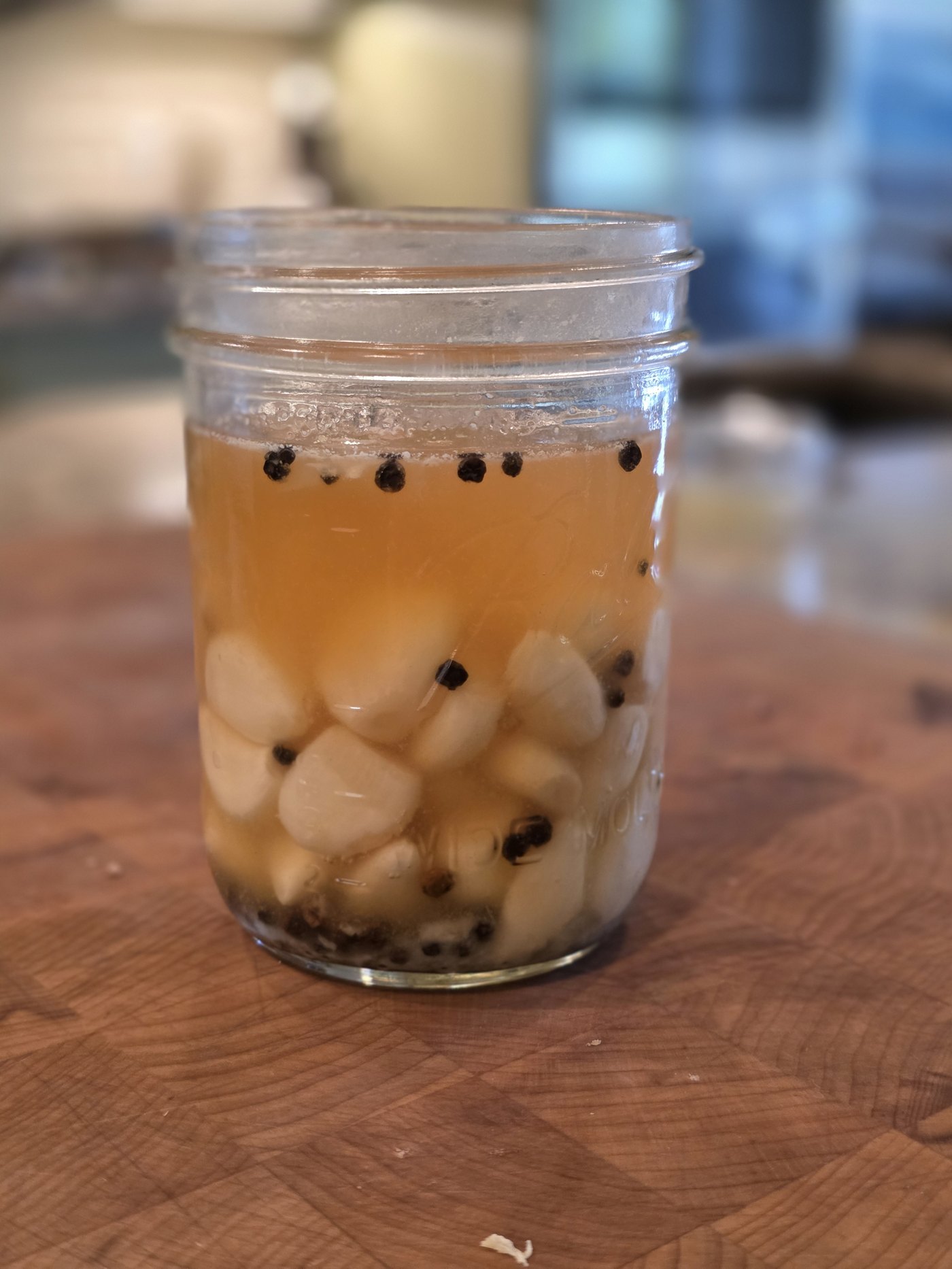
Because the gut is such a direct line to hormone balance, I paired this one with a ferment that's almost embarrassingly simple: lacto-fermented garlic with yogurt whey. The whey kickstarts the fermentation, the process mellows garlic's raw bite into something nutty and almost sweet, and you end up with a jar of probiotic-rich cloves (and a gut-friendly brine) that quietly feed your estrobolome. And don't worry — you won't be crunching raw cloves. The recipe comes with a creamy fermented-garlic dressing and six easy ways to fold it into food you're already making.
Get the recipe — plus 6 ways to use it →
The endocrine system isn't as mysterious as it sounds. It's a conversation — and every steady meal, every good night's sleep, every small swap helps keep that conversation calm and clear. More to come.
Sources: 1 Nussey, S., & Whitehead, S. (2001). Principles of Endocrinology. BIOS Scientific Publishers / NCBI Bookshelf, NBK20. | 2 Zhu, L., et al. (2023). Gut microbial beta-glucuronidase: a vital regulator in female estrogen metabolism. Gut Microbes, 15(1), 2236749. | 3 Kwa, M., Plottel, C.S., Blaser, M.J., & Adams, S. (2016). The intestinal microbiome and estrogen receptor–positive female breast cancer. JNCI, 108(8), djw029. | 4 Xenoestrogens / endocrine-disrupting chemicals: non-endogenous compounds (e.g. BPA, phthalates) that bind estrogen receptors and disrupt normal signaling.
Photos by Ashley Crawford / Nourish Wise