The Terrain Series, No. 5. A series on how everyday food shapes the body's inner terrain — the conditions that either invite disease or help keep it at bay. This week: the science underneath every post so far.
If you've been following this series, you've heard me talk about a lot of single foods — green tea, wild salmon, the four seeds, the sugar question. This week I want to pull the camera back and show you the thing that connects all of them. Because there's one mechanism underneath every post I've written, and once you see it, the whole "food as terrain" idea clicks into place.
It's called epigenetics. And it might be the most hopeful science I know.
"It runs in my family, so it's coming for me too."
I hear some version of this all the time. My father died of a heart attack. My grandfather did too. So I'm next — it's just a matter of time. People carry that like a prison sentence that's already been handed down. And I understand why. When you watch the same thing take the people you love, it's hard not to assume you're standing in the same line.
But here's the part most people were never told: there's more to the story.
Let me get personal for a minute, because I believe this from the inside, not just from a textbook. My mom died of early-onset Alzheimer's. She also drank heavily — as so many people who came of age during the Vietnam era did. It seemed to be the coping strategy of a whole generation, and a lot of them never set it down. I'm not telling you this to blame her. I loved her, and I understand why that glass was always within reach. I'm telling you because alcohol is one of the most powerful daily signals you can send your brain and your genes — and it was a steady fixture of the terrain she lived in.
Here's the part I sit with: I'm already older now than she was when she was diagnosed. I don't say that as a victory lap — I know better than to think any of us is handed guarantees. I say it because it's the whole point of this post. Her genes and mine overlap. Our terrain doesn't. And terrain is the part you get a say in.
Why can two people eat a similar diet, live similar lives, and end up with completely different health? Why does heart disease — or cancer — run hard through some branches of a family and skip others entirely? Why do your own symptoms flare some weeks and quiet down others?
The old answer was "it's in your genes." But here's what the research actually shows: it's not just the genes you have — it's what your body does with them. And food is one of the most powerful tools you have to change that conversation.
This matters enormously for the diseases we fear most. Only a small fraction of cancers — and a minority of heart disease — come from a single gene you inherited and can't change. The far larger share is shaped by how your genes get expressed — switched on, switched off, turned up, turned down — across a lifetime. That switching is epigenetics. And diet is one of its loudest inputs.1
Family history isn't a prison sentence. It's a tendency — a thumb on the scale, not a verdict. And a lot of what tips that scale back the other way happens on your plate.
Your body has an on/off switch — and food helps work it
Here's the simplest way I know to picture it.
Your DNA is a massive library of instruction books. You were born with all of them. But not every book gets read — your daily life decides which ones get pulled off the shelf and opened, and which sit there gathering dust.
What you eat, how you sleep, how much stress you carry — all of it sends signals about which instructions to follow. Some signals calm inflammation and help your cells repair and behave. Others turn up the volume on the very processes that, over years, help cancer get a foothold.
You don't need a biology degree to use this. You just need to know which foods send which signals.

The foods that work in your favor
Certain whole foods contain compounds that actively signal your body to calm down, repair, and protect — nudging gene expression toward the patterns associated with a healthier terrain. Researchers call these epi-nutrients.2 Here's the lineup — and you'll notice some old friends from this series:
| Food | Key compound | What it's doing |
|---|---|---|
| Broccoli, cauliflower, Brussels sprouts | Sulforaphane | Helps switch off inflammation at the source; supports the body's natural clearance pathways |
| Turmeric | Curcumin | One of the most-studied anti-inflammatory compounds in nature; supports the pathways that keep cells behaving |
| Organic green tea | EGCG | Calms overactive immune signals that drive chronic inflammation (our very first post) |
| Blueberries, blackberries, elderberries | Anthocyanins, resveratrol | Protect cells from oxidative damage; support healthy circulation |
| Wild-caught salmon, sardines, mackerel | Omega-3 fatty acids | Directly lower inflammatory signaling (post No. 3) |
| Pasture-raised eggs | Choline, folate | Feed the body's methylation cycle — a core part of how genes get switched on and off |
| Leafy greens & beets | Folate, betaine | Also feed methylation, a core process that helps regulate healthy gene expression |
Look at that list again. Green tea. Salmon. Cruciferous vegetables. This whole series has quietly been a tour of epi-nutrients — different foods, same underlying job: sending your DNA better messages.
The honest part
Let me be clear, because this is exactly the kind of idea that gets oversold. Epigenetics does not mean food rewrites your genome, reverses cancer, or replaces medical care. Anyone promising that is selling something.
Something gentler and, to me, more powerful: the food you eat is a real and measurable influence on how your genes behave — one input among several (sleep, stress, movement, environment), but a daily one, and one you control three times a day. You're not erasing your genetics. You're shaping the terrain they operate in. That's the whole philosophy of this series, told at the level of the cell.
Simple daily shifts
You don't have to overhaul everything overnight. Start here:
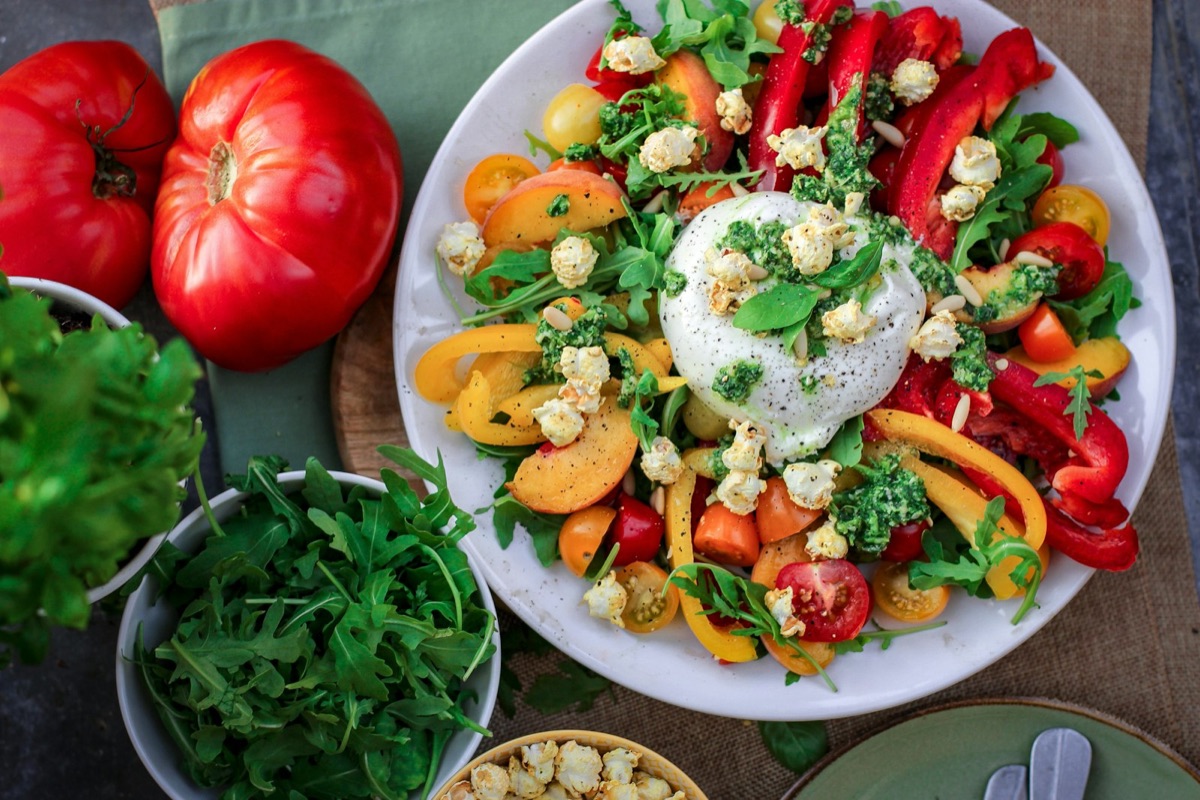
- Add a cruciferous vegetable 3–4 times a week — broccoli, kale, arugula, cabbage.
- Cook with turmeric, and pair it with black pepper (it makes the curcumin dramatically more usable).
- Swap one daily drink for a cup of organic green tea.
- Eat wild-caught fatty fish 2–3 times a week.
- Include dark berries 4–5 times a week — fresh or frozen both count.
- Ease off sugar and processed foods — they actively work against everything above.
Your terrain didn't shift overnight, and it won't shift back overnight either. But every meal is a message. The more consistently you send the right ones, the more your body listens.
Bring it to your plate
I turned this whole idea into one pan. My roasted cauliflower & grass-fed beef skillet stacks three of the epi-nutrients above into a single dinner — sulforaphane from the cruciferous trio, folate from the kale, curcumin from the turmeric — with a built-in lesson on cooking the beef gently to keep the terrain friendly.
You are not your genes. You're the daily, repeatable set of signals you send them. That's not a small thing — it's just about the most empowering thing I know. More to come.
Sources: 1 Barrero, M.J., Cejas, P., Long, H.W., & Ramirez de Molina, A. (2022). Nutritional epigenetics in cancer. Advances in Nutrition, 13(5), 1748–1761. | 2 Bakrim, S., El Omari, N., El Yaagoubi, O.M., et al. (2025). Epi-nutrients for cancer prevention: molecular mechanisms and emerging insights. Cell Biology and Toxicology, 41(1), 116.
Photos via Unsplash.