
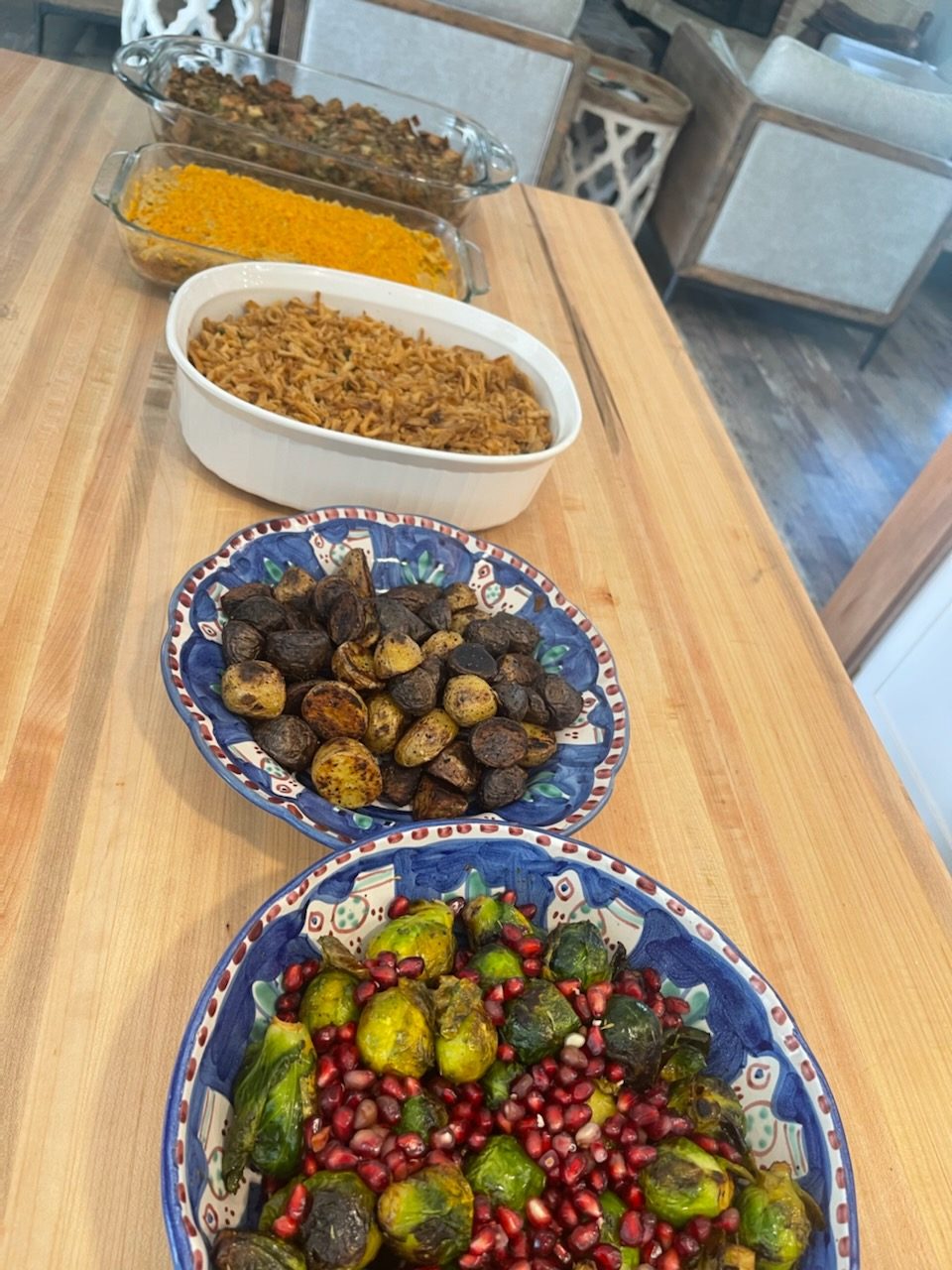
Holiday Survival Series, Part 1. This is part one of my holiday survival series, where we'll take the season one piece at a time. We're starting with blood sugar because it touches almost everything else: your energy, your mood, your cravings, even your sleep.
If there's a bowl of leftover Halloween candy sitting on your counter right now, quietly calling your name every time you walk by, this one's for you.
We've officially entered the season. From now until New Year's, it's one long stretch of office treats, potlucks, cookie swaps, Thanksgiving plates, and “just one more” pieces of pie. And I want to say this up front: I am not here to take the pie away. Holiday food is tied up with family, memory, and tradition. That matters.
What I do want is for you to get to January feeling like yourself. Not wiped out, not riding a sugar rollercoaster, not wondering why you're starving an hour after a huge meal. Learning how to balance blood sugar during the holidays is one of the simplest ways to get there, and it has nothing to do with willpower.
What a blood sugar rollercoaster actually feels like
When you eat something sugary or starchy on its own, blood sugar climbs quickly. Your body releases insulin to bring it back down, and sometimes it overshoots. That drop is the crash.
You might know a blood sugar crash better by how it feels:
- Shaky, irritable, or flat-out hangry
- Foggy and tired, especially mid-afternoon
- Craving something sweet again a couple of hours after eating
- Wired at bedtime, or waking up in the middle of the night
Now stack that pattern day after day, party after party, for eight weeks. That's why so many of us limp into the new year exhausted, puffy, and swearing off sugar forever (until about January 9th).
Foundations first: blood sugar doesn't work alone
The way I work with clients is foundations first: digestion, blood sugar regulation, stress, sleep, and a nutrient-dense way of eating. These aren't five separate boxes. They talk to each other constantly.
Poor sleep makes your blood sugar harder to manage. Stress hormones push blood sugar up. Rushed eating makes digestion harder. So when we talk about how to balance blood sugar naturally, we're really talking about the whole picture, not just what's on the plate.
Here's the good news: you don't have to fix everything at once. A few small habits do a lot of the heavy lifting.
8 ways to balance blood sugar during the holidays
1. Don't show up to the party starving.
Skipping lunch to “save room” for the big dinner sounds smart. In practice, it usually means you arrive ravenous, and the first thing you reach for is the bread basket or the cheese-and-cracker tray. Instead, have a small snack with protein, fat, and fiber an hour or so before you go. A handful of nuts, an apple with nut butter, a hard-boiled egg, or hummus with veggies all work. That's my answer when people ask what to eat before a holiday party: something real, something small, something with staying power.
2. Eat your plate in order.
This one is almost too easy. Start with the vegetables and protein, and save the starches and sweets for later in the meal. In one small study of 11 adults with Type 2 diabetes, eating the protein and vegetables 15 minutes before the carbs lowered after-meal blood sugar by roughly 30 to 40% in the first hour, and insulin was lower too.1 Same food. Different order. So go ahead: green beans and turkey (or lentil loaf, or whatever your plate holds) first, then the rolls and the sweet potatoes.
3. Never let a carb go out alone.
I like to think of it as giving your carbs a buddy. Pair starches and sweets with protein, fat, or fiber, and they hit your bloodstream more gently. Practically, that means dessert after a meal instead of on its own at 3 p.m., and cookies with a handful of nuts instead of a plate of cookies by themselves.
4. Slow down and actually chew.
If you've been reading along for a while, you know I'm the slowest eater at every table. Turns out that's a gift. Eating slowly gives your digestion a head start and gives your brain time to notice you're full before you're uncomfortably full. Put the fork down between bites. Talk to your people. The pie isn't going anywhere.
5. Take a short walk after you eat.
This is my favorite holiday tradition to recommend because it's free and it's good for the whole family. Light movement after a meal helps your muscles pull sugar out of your bloodstream. In one study of 41 adults with Type 2 diabetes, after-meal blood sugar ran about 12% lower with a 10-minute walk after each meal than with one 30-minute walk at another time of day, and about 22% lower after dinner.2 A review that pooled seven studies found that breaking up long stretches of sitting with short, light walks lowered after-meal blood sugar and insulin, and worked better than just standing up.3 Grab a jacket, get everybody outside, and look at the leaves (or the Christmas lights) for 10 to 15 minutes.

6. Protect your sleep.
Late nights, travel, and a packed calendar take a real toll on sleep this time of year. In a small study of nine healthy adults, one night of about four hours' sleep made their bodies about 25% less responsive to insulin the next day.4 One night! So if you've got a big gathering on Saturday, try to get to bed at a decent hour on Friday. Your blood sugar and your patience will both thank you.
7. Make room to decompress.
The holidays are joyful and also, let's be honest, a lot. Stress hormones like cortisol raise blood sugar to give you quick energy, which made great sense when stress meant running from something and makes less sense when stress means hosting 14 people. Build in small pauses: a few deep breaths before you walk into the room, ten quiet minutes with your coffee, a warm bath before bed. Magnesium-rich foods help here too (I wrote all about that in The mineral behind the calm).
8. Watch the drinks.
Holiday drinks are sneaky. Eggnog, sweet cocktails, hot cider, and fancy coffee drinks can carry as much sugar as dessert. Enjoy the one you really love, have it with food rather than on an empty stomach, and keep a glass of water going in between.
What about the leftover Halloween candy?
No guilt required. If you want a piece, have it right after a meal instead of grazing on it all afternoon. And if that bowl is calling you a little too loudly, it's okay to send it to work with someone, give it away, or put it somewhere out of sight. Out of sight really does help.
When blood sugar needs more than holiday tips
Sometimes those crashes, cravings, and 3 a.m. wake-ups aren't really about the holidays at all. If you notice them year-round, or your fasting glucose or A1c has been creeping up, that's worth a deeper look. Fasting insulin is a lab I love here, because it can show your body working harder to manage blood sugar long before glucose itself looks high. And if you want to dig into one therapeutic approach, I've written about a ketogenic approach to Type 2 diabetes.
Important
If you take insulin, Ozempic, Mounjaro, metformin, or any other medication that lowers blood sugar, please talk with your doctor before changing how you eat. As blood sugar improves, medication needs can change, and that should always be managed with your provider.
Work with a Nutritional Therapy Practitioner in Southwest Missouri and Northwest Arkansas
There's no single right way to eat for everyone, and that includes how to balance blood sugar during the holidays. Your body, your history, and your stress load are your own. If you're tired of riding the rollercoaster and want a plan built around you, I'd love to help. I work with clients in person in Southwest Missouri and Northwest Arkansas, and virtually anywhere in the U.S.
It starts with a free 30-minute discovery call. Book yours here, and let's get you to January feeling like yourself. 🌿
Next Monday, part two of the holiday survival series. See you then!
Sources:
1 Shukla AP, et al. Food order has a significant impact on postprandial glucose and insulin levels. Diabetes Care. 2015;38(7):e98–e99.
2 Reynolds AN, et al. Advice to walk after meals is more effective for lowering postprandial glycaemia in type 2 diabetes mellitus than advice that does not specify timing: a randomised crossover study. Diabetologia. 2016;59(12):2572–2578.
3 Buffey AJ, et al. The acute effects of interrupting prolonged sitting time in adults with standing and light-intensity walking on biomarkers of cardiometabolic health in adults: a systematic review and meta-analysis. Sports Medicine. 2022;52(8):1765–1787.
4 Donga E, et al. A single night of partial sleep deprivation induces insulin resistance in multiple metabolic pathways in healthy subjects. Journal of Clinical Endocrinology & Metabolism. 2010;95(6):2963–2968.
This information is educational and not a substitute for medical advice. Always consult your healthcare provider before making changes to your medication.
Work with Ashley
If the crashes and cravings show up all year, not just in December, let's look at what your body is asking for. It starts with a free 30-minute discovery call.
See How We Work Together